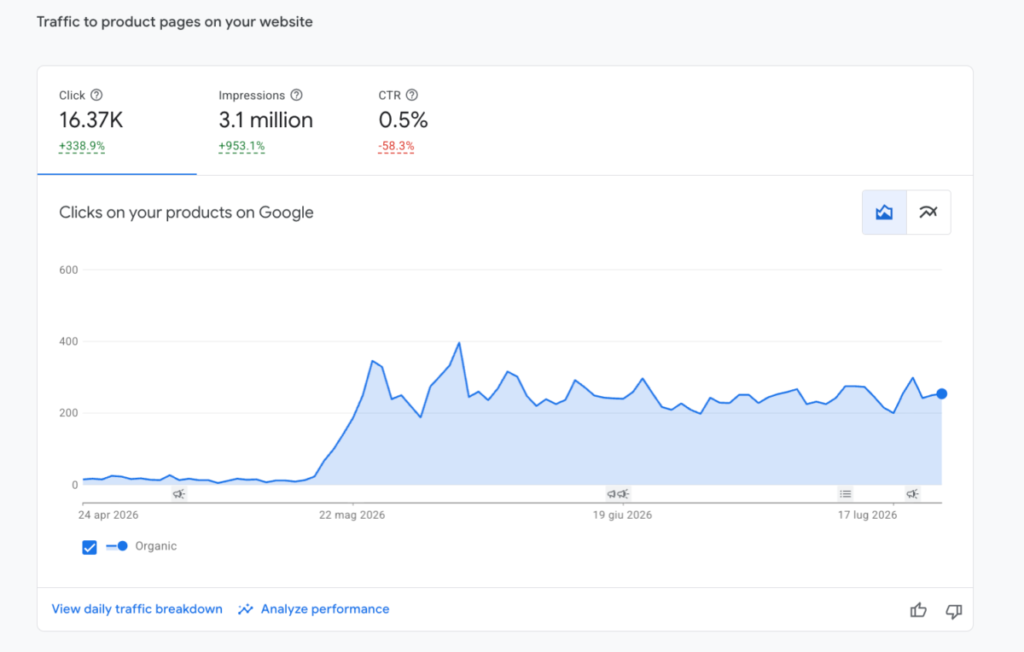
Achieved 338% Growth in Google Shopping Clicks


How I Achieved 338% Growth in Google Shopping Clicks

This case study walks through the repeatable four-phase process we use to diagnose and fix failing feeds, applied here to a mid-size ecommerce with 10,000+ products. It applies to any vertical.

The core problem: The client’s feed was built around internal warehouse logic (model names, SKU conventions) instead of how customers search.

Before touching anything, we asked: What’s the gap between how we’re describing products and how customers are finding them?

What I did: Four phases

Phase 1: Title Pattern Audit

We picked 20-30 of the client’s best-sellers and searched them on Google Shopping.

We studied what competitor titles included in the first grid:

  • what details were they leading with?
  • what was missing from ours?

The client had the data but wasn’t surfacing it, internal model names like “- Priverno” were taking up space where material, dimensions, or seat count should go.

We documented the pattern gap, tested new title patterns on a small sample, then scaled the approach.

Phase 2: Category Taxonomy Alignment

We downloaded Google’s official Product Type Taxonomy and mapped it against the client’s categories.

What we found: they were using generic parent categories (“Furniture” ID 436) when specific leaf nodes existed (“Furniture > Bedroom Furniture > Sofa Beds” ID 3966).

This mismatch was causing disapprovals and limiting how Google filtered products.

We built a corrected mapping and uploaded it via supplementary feed, no website changes needed. The specificity immediately prevented hundreds of mis-categorizations.

Phase 3: Attribute Completeness

We went back to our Phase 1 analysis and looked at competitor titles.

Material showed up in 90%+ of them. Size variants in 80%. Mechanism in 70%.

We checked the client’s feed: material was missing on 95%+ of sofas, sofa beds, and sideboards.

The data existed on product pages, in the CMS, in supplier sheets but wasn’t in the feed.

We added the core missing attributes at the source and prioritized high-volume categories.

Phase 4: Disapproval Cleanup

We exported all disapprovals and grouped them by issue type:

  • missing price
  • unable to view on mobile
  • price mismatch
  • etc.

For each group, we determined if it was a feed problem, website problem, or data sync issue.

We tracked everything systematically.

This phase came last because most disapprovals were symptoms of the structural problems we’d already fixed, broken taxonomy, missing attributes. Once structure was corrected, cleanup was straightforward.

The Results

Clicks on product pages: 16.37K clicks, up 338.9% from baseline.

Impressions: 3.1 million, up 953.1%.

The trajectory is visible in the chart: clicks climbed from near-zero in late April to a sustained 200-300 daily by mid-July, with spikes to 400+. Impressions followed.

What I can do for you

If your feed looks like the client's did sitting on data that customers can't find you don't need a relaunch. You need to see the gaps first.

I run Google Merchant Center audits that follow this exact framework: title pattern mapping against your actual searcher behavior, taxonomy alignment to Google's structure, attribute completeness against your category benchmarks, and disapproval diagnosis by root cause.

Most of the work is diagnostic. Once you see what's broken, fixes are straightforward.

If your Shopping performance feels flat despite having inventory that should sell, a 2-hour audit tells you which phases will move the needle for your business.

Let's talk about your feed.

  • Ecommerce SEO Consultant & Founder at Searchind
  • I work with medium- to large-sized ecommerce. Only a few projects at a time. Direct accountability (no juniors, no generalists).
  • Ecommerce SEO trainer for freelancers, agencies, and companies.
  • Follow me on Linkedin.

Searchind - Ecommerce SEO + Strategy

The Searchind Newsletter is written by Simone Parodi, an international SEO consultant for eCommerce. He helps many eCommerce businesses achieve qualified organic traffic and increase their revenue.

Read more from Searchind - Ecommerce SEO + Strategy

SEARCHIND PIM (Product Information Management) for Ecommerce and Shopify Simone Parodi Organic Growth and SEO for DTC & Ecommerce AI is fundamentally changing how customers discover products. Your product data now powers Google’s AI Overviews, LLM shopping experiences, and recommendation engines, but only when it’s complete and accurate. When product data is incomplete or inconsistent, both customers and AI systems struggle. AI can’t understand and represent your offerings accurately without...

SEARCHIND Mentioned doesn't mean cited When AI answers a shopping question, it does two things at once. It recommends brands ("good options include...") and it cites sources to back up that recommendation ("according to..."). The problem most ecommerce teams miss is that these require different content, different targeting, and honestly, different time horizons. For years, optimization meant one thing: rank higher on Google organic. Now you're optimizing across four AI surfaces, ChatGPT,...

SEARCHIND One-off consultancy to recover lost rankings Delicatezza is a UK‑based online Italian food shop that sells a wide range of authentic Italian groceries GOAL: The objective was to recover average search positions lost on Google. For this client, I conducted a detailed analysis to recover the lost rankings. I created a comprehensive Google Sheet outlining the recommended technical SEO activities, along with their priority and implementation order. Some activities we did: 404 Pages -...